Why this bridge matters
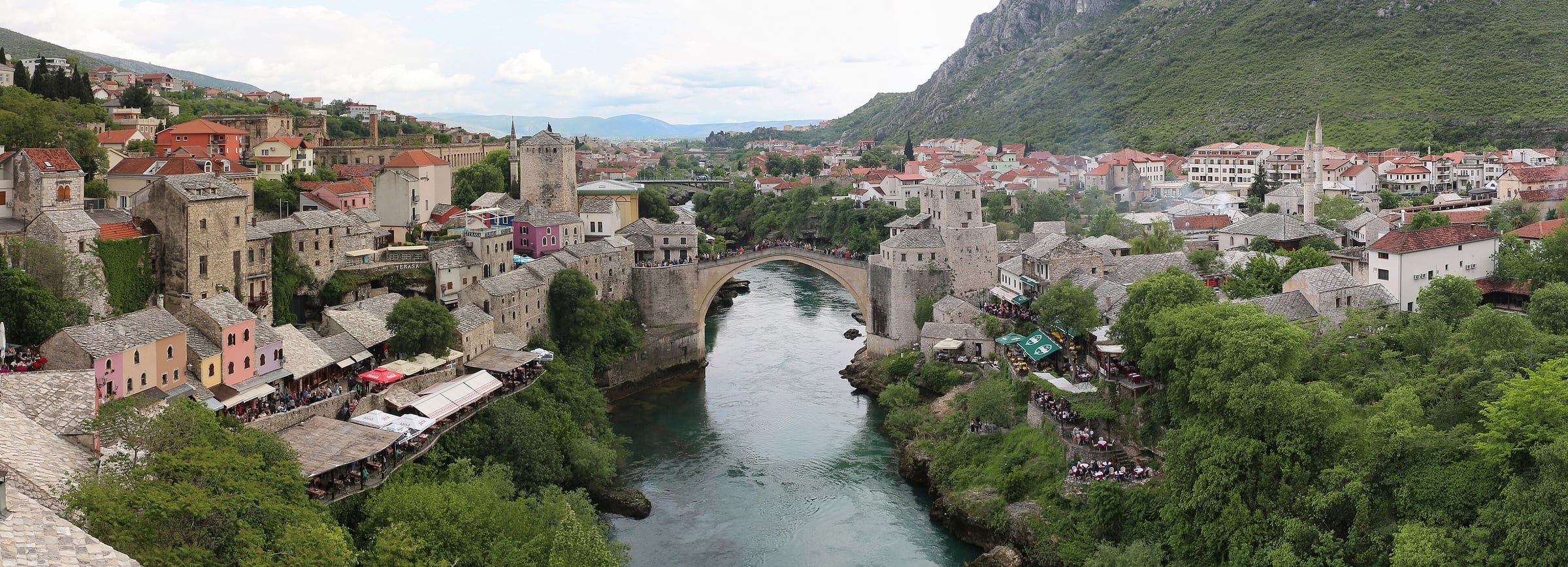
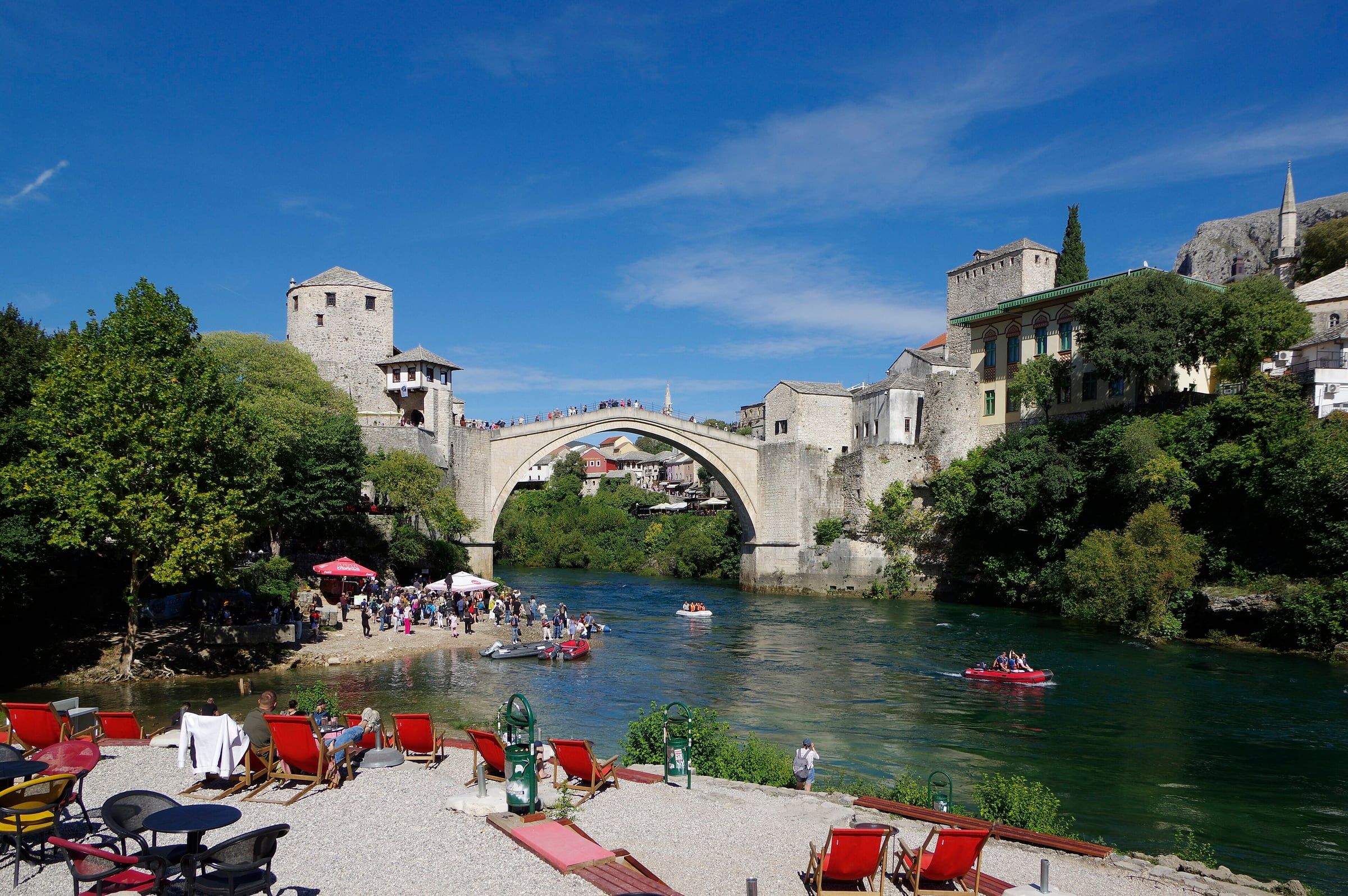
Stari Most means “Old Bridge”. It is a single hump-backed stone arch over the Neretva, and the city of Mostar takes its name from the men who guarded it. Wikipedia says the two fortified towers at its ends, Halebija on the north-east bank and Tara on the south-west, are known as the bridge keepers, or mostari.
The bridge is not just a pretty arch. It tells you most of what you need to know about the town: Ottoman engineering, a river that divides, and a war that cut the bridge in two. If you only have a few hours here, this is the place to spend some of them. See the Old Town page for what surrounds it.
A short history
Suleiman the Magnificent commissioned the bridge in 1557. Mostar had grown in importance under Ottoman rule, and the old wooden suspension bridge over the gorge was no longer safe. The designer was Mimar Hayruddin, a pupil of the great architect Mimar Sinan. Work was completed in 1566. The inscription gives 974 in the Islamic calendar, which is roughly 1566 to 1567.
Wikipedia puts the bridge at about 24 metres above the river and about 30 metres long. It is a single span, so there is no pier in the water.
On 9 November 1993 the bridge fell into the Neretva after shelling during the Croat-Bosniak War. Our war history page sets out the wider story. The International Criminal Tribunal for the former Yugoslavia, the UN court that tried wartime crimes, found in the Prlić case that the bridge was a legitimate military target for the HVO (the Bosnian Croat forces), but that destroying it caused disproportionate damage to the Bosniak civilian population. Many scholars see its destruction as a deliberate attack on the city’s shared heritage.
Rebuilding it
Reconstruction began on 7 June 2001. The aim was to copy the original as closely as possible, with the same materials and Ottoman building methods. The stone is a fine-grained limestone called Tenelia, from local quarries. Hungarian army divers pulled original stones out of the river, though Wikipedia says most were too damaged to reuse. A Turkish-led group of engineering firms did the building, with the World Bank, UNESCO, the Aga Khan Trust for Culture and the World Monuments Fund overseeing it.
The bridge was inaugurated on 23 July 2004. In 2005 it was inscribed as a UNESCO World Heritage Site under the name “Old Bridge Area of the Old City of Mostar”. Note the wording: the listing covers the bridge and the old city around it, not the bridge alone.
The towers and the Old Bridge Museum
The Tara tower is on the left bank beside the bridge and holds the Old Bridge Museum, run by the Museum of Herzegovina. According to the museum’s own page, it has exhibits on the bridge and its reconstruction, an archaeological site below the tower, documents on the upper floors and an observation deck at the top.
Entry was about 8 KM when a March 2026 guide checked, but that is a secondary source and prices change. Ask the museum for current details on +387 36 551 602 or info@muzejhercegovine.com. A KM is a convertible mark, the local currency, pegged at 1.95583 to the euro. One search result gave opening hours of Tuesday to Sunday, 10:00 to 18:00. We could not confirm that on an official page, so check before you plan around it.
Our view: go up for the observation deck if you want a high angle on the arch and the river, and skip it if you are short of time. The bridge itself is free to cross and looks better from outside than from the top of a tower.
The bridge divers
Every year, at midsummer (the end of July), young men of the town jump from the bridge into the Neretva. Wikipedia says a formal competition began in 1968 and has run every summer since. The river is very cold, and Wikipedia notes the jump demands skill and training. Since 2015, Mostar has also been a stop on the Red Bull Cliff Diving World Series.
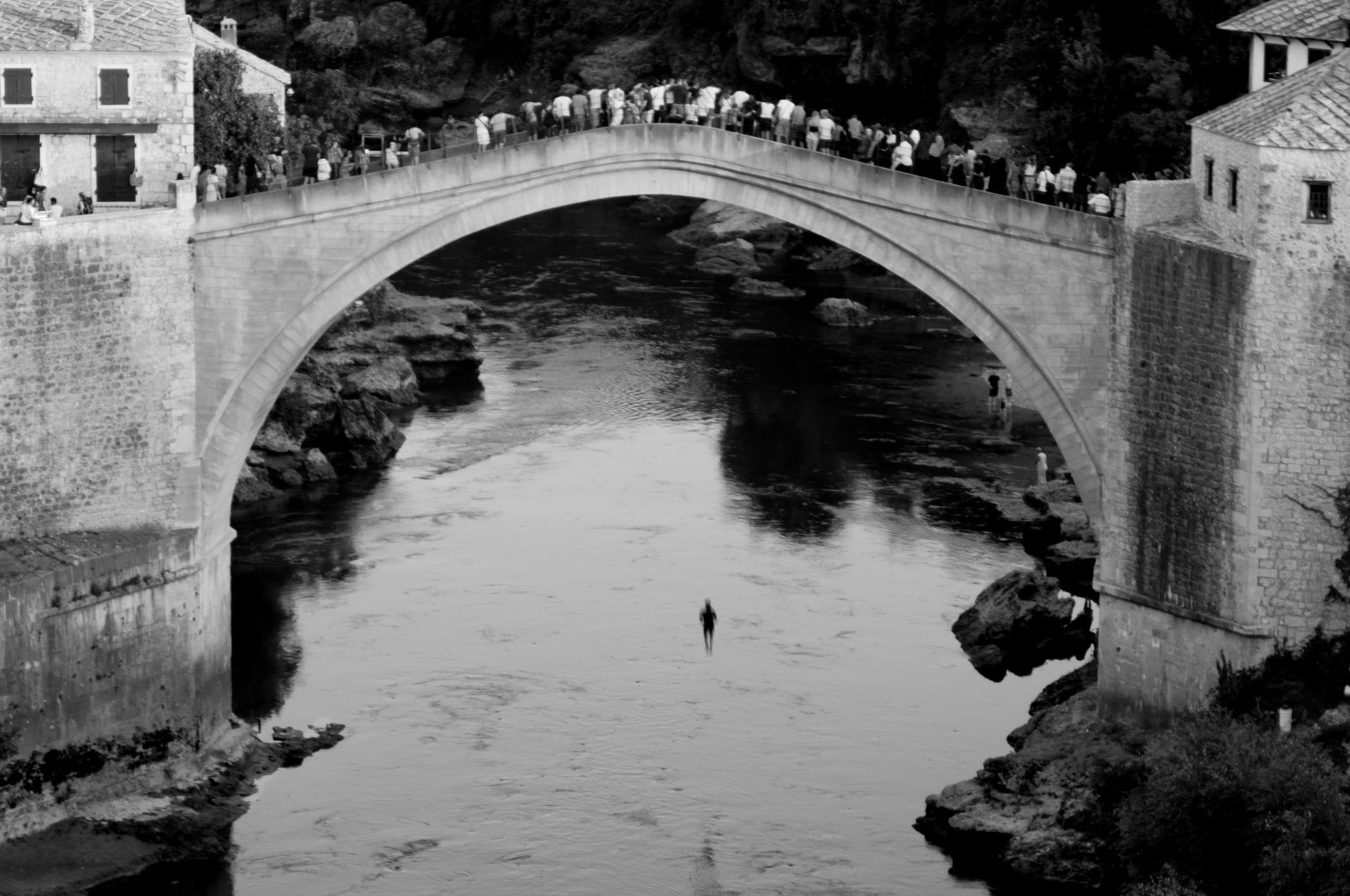
Outside the competition, divers also jump for tips during the season. Guides say the divers collect money from the crowd before they jump. Amounts quoted vary widely and we could not verify any, so do not rely on a figure. The usual courtesy is to give what you think is fair after watching. A Lonely Planet listing, which we saw only in search results, names the Mostari Divers’ Club as the local club.
Do not jump yourself
The UK government’s travel advice says diving off the bridge is dangerous and has caused serious injuries and deaths. Some guides say visitors can arrange a jump through the club after practice jumps from lower down. We could not verify that, and we would not encourage it. Watching is the better plan.
Where to look at the bridge
- On the bridge. Cross it slowly. It is a busy thoroughfare, so people stop mid-arch for photographs.
- The river bank below. Our hero photo was taken from the shingle at river level, where you see the full arch with a tower at each end.
- The Tara tower deck. The museum’s observation deck gives a view along the river and over the arch.
- Either bank at the ends. Walk back from the bridge on both sides of the river and look back. The Old Town page covers the Koski Mehmed Pasha Mosque, whose river terrace is a good place to photograph the bridge.
On timing, we have no verified crowd data. As a suggestion rather than a fact, the middle of the day is the time most day trips arrive, so early morning or later in the afternoon should be quieter. If you are staying overnight, you can look at the bridge when the coach parties have gone. Our Mostar itinerary and best time to visit pages go into pacing.
Practical tips
- The bridge is free to cross. We have no verified information on how slippery the stone surface is, so watch your footing in wet weather and wear shoes with grip.
- Wikipedia lists July highs of about 33 C, so bring water and a hat in summer.
- Allow about 30 minutes for the bridge and both banks, and about an hour with the museum (our estimates).
- If you are coming from the coast, see Mostar from Dubrovnik and our day tours page.
What the bridge looks like up close
The arch is steep. Wikipedia describes the bridge as hump-backed, with limestone abutments at each end and an arch that rises 12.02 metres. In practice that means a climb up and a descent down on the far side, and people stop at the crown to look at the water. Give yourself time to cross it twice: once to get over, once to look back.
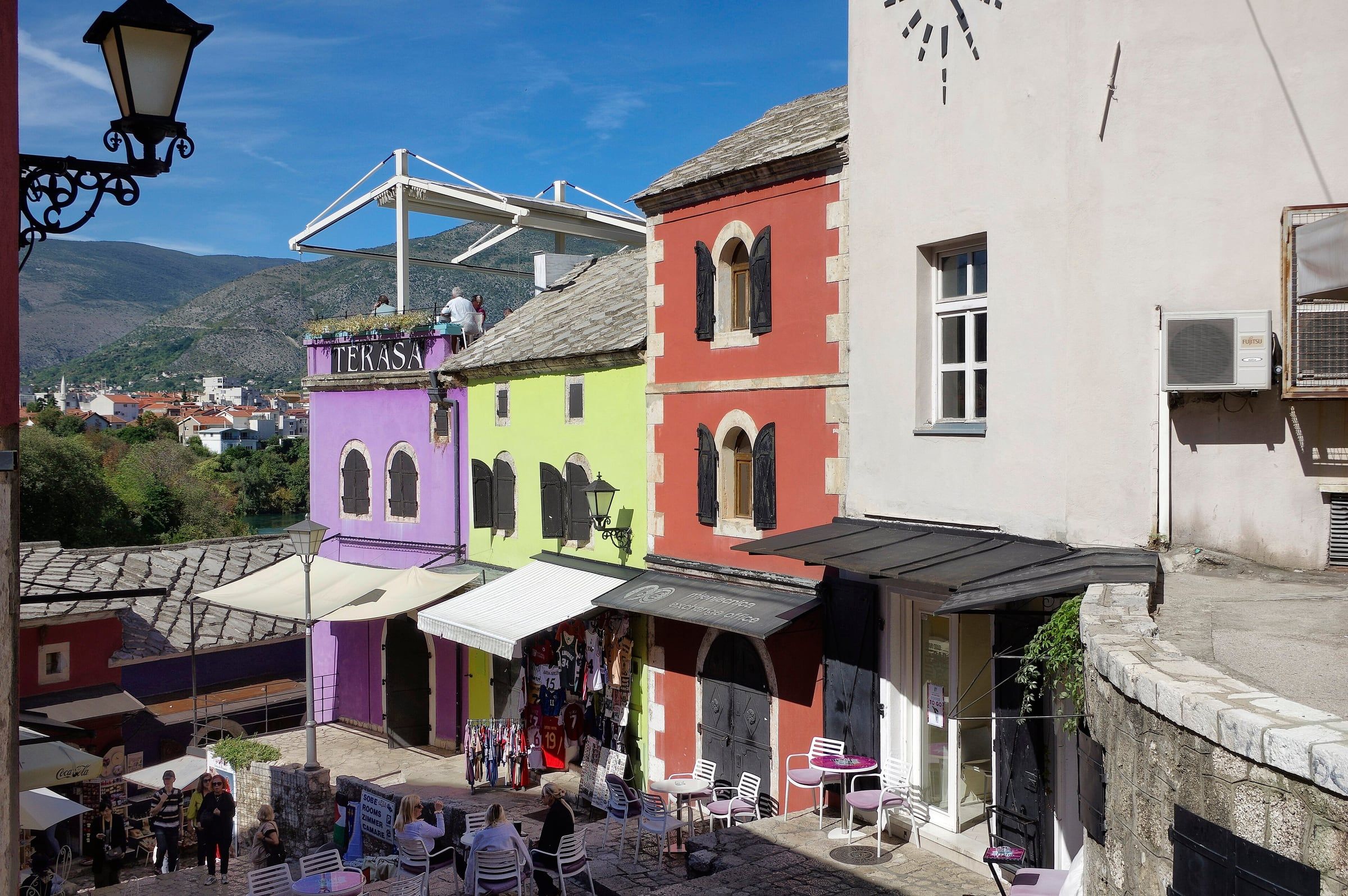
On either side the towers give the crossing a gateway feel, and the stone lanes of the Old Town run off from each end. If you are visiting as a day trip from the coast, the bridge is where many groups are given free time, so it is also where you will most often meet other tour parties. Our getting there page and the Dubrovnik page explain how to arrange your own timing, and the Kravice waterfalls page covers the most common second stop.